
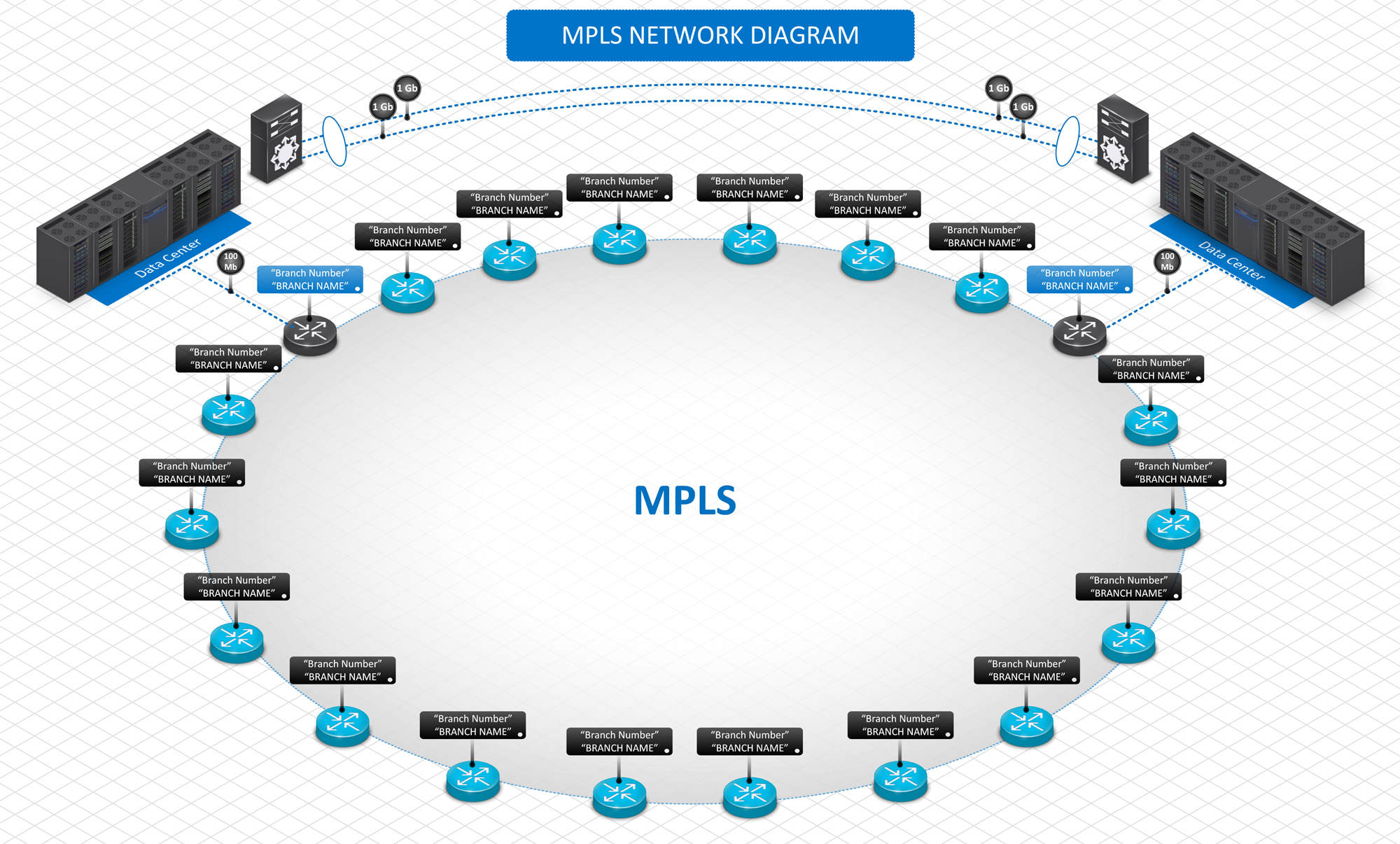
3D Network Templates
3D Template 8 MPLS
$14.99
Format: Microsoft Visio (.vsdx) – also imports into Visio-compatible software
- Perpetual licence: no expiry and no yearly fee
- Download link straight after payment
- Works with Microsoft Visio and Visio-compatible software
- Included in every subscription plan
Need lots of products? A subscription includes everything.
Not sure yet? Try the free network symbols pack first to check the quality.
About this product
MPLS (Multiprotocol Label Switching) is a highly scalable and efficient data-carrying technique that directs data from one network node to the next based on short path labels rather than long network addresses. This significantly accelerates traffic flow and improves the efficiency of network management.
Key Components
- Labels:
- MPLS uses labels to make forwarding decisions. These labels are assigned at the entry point of the network and determine the path the data packet will take across the network, ensuring high-speed and deterministic performance.
- Label Edge Routers (LERs):
- LERs operate at the edge of the MPLS network, where they assign labels to incoming packets and remove labels from outgoing packets. They play a crucial role in interfacing with non-MPLS networks.
- Label Switch Routers (LSRs):
- Located within the MPLS network, LSRs make forwarding decisions based solely on the labels. They switch the labels according to predefined routing paths to maintain efficient and fast data transmission.
Design Considerations
- Scalability:
- MPLS networks are highly scalable, accommodating growing data traffic and an increasing number of network nodes without a significant drop in performance. This makes MPLS suitable for large enterprise and service provider networks.
- Quality of Service (QoS):
- MPLS supports advanced QoS mechanisms, ensuring that critical applications receive the necessary bandwidth and low latency. This is particularly important for real-time applications like VoIP and video conferencing.
- Traffic Engineering:
- MPLS allows for sophisticated traffic engineering capabilities, enabling network administrators to optimize the flow of traffic across the network. This ensures efficient utilization of network resources and avoids congestion.
- Redundancy and Failover:
- MPLS networks can be designed with redundancy and failover mechanisms to ensure high availability. This involves setting up backup LSPs (Label Switched Paths) that can take over in case of a primary path failure.
Benefits
- Speed and Efficiency:
- By using labels to route data, MPLS reduces the complexity of lookups in the routing table, speeding up the packet forwarding process.
- Flexibility:
- MPLS can transport any payload, including IPv4, IPv6, Ethernet, and ATM. This flexibility allows it to support a wide range of applications and services.
- Enhanced Security:
- While MPLS itself is not a security protocol, its use in creating isolated virtual private networks (VPNs) adds a layer of security by segregating traffic between different customers or services.
In summary, MPLS design offers a robust, scalable, and efficient solution for modern network requirements, providing high-speed data transfer, enhanced QoS, and advanced traffic engineering capabilities. This makes it a preferred choice for large-scale enterprise and service provider networks